

At temperatures between 1500°C and 2500°C (2732°F to 4532°F), a human body would undergo immediate and total destruction. This temperature range is far beyond what is required for standard cremation and enters the realm of industrial steel manufacturing or volcanic activity.
Here is the step-by-step breakdown of what occurs at these extreme temperatures:
1. Instantaneous Thermal Destruction
To put this in perspective, standard cremation occurs at roughly 760°C to 1000°C. At 1500°C–2500°C:
Vaporization of Soft Tissue: The water in the human body (which is about 60-70% of its mass) would flash-boil into steam instantly. This would likely cause an explosive expansion of gases within the tissues.
Sublimation and Combustion: Carbon-based tissues would ignite and oxidize almost immediately. At the higher end (2500°C), many organic compounds do not just burn; they begin to undergo thermal decomposition (pyrolysis) at a molecular level within seconds.
2. Destruction of Bone
In a standard cremation, bones do not actually turn to “ash”; they remain as brittle fragments that must be mechanically ground down. However, at 1500°C and above:
Calcination: The hydroxyapatite (the mineral that gives bones their strength) would rapidly calcify and lose all structural integrity.
Melting Points: While bone doesn’t have a single “melting point” because it is a complex composite, its mineral components begin to undergo significant phase changes. At 1670°C, calcium phosphate (a major component of bone) reaches its melting point.
Total Dissolution: By 2500°C, even the most resilient mineral structures of the body would be reduced to a liquid or gaseous state or a fine, glass-like slag.
Summary
At these temperatures, there is no “process” of dying; the transition from biological matter to basic elements (carbon, steam, and mineral slag) is essentially instantaneous. The body would not leave behind “ashes” in the traditional sense, but rather a small amount of molten mineral residue or vapour.
The correspondent needs basic knowledge of explosive technology to understand all these processes. This not an accident but a high end process involving very high temperatures and instantaneous chemical reaction that hardly leaves any trace.
Many have gone or disappeared into thin air.
Gen. Briggs.
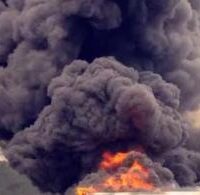
(Screenshot from Video Posted by Olutoyosi Omotoso)