
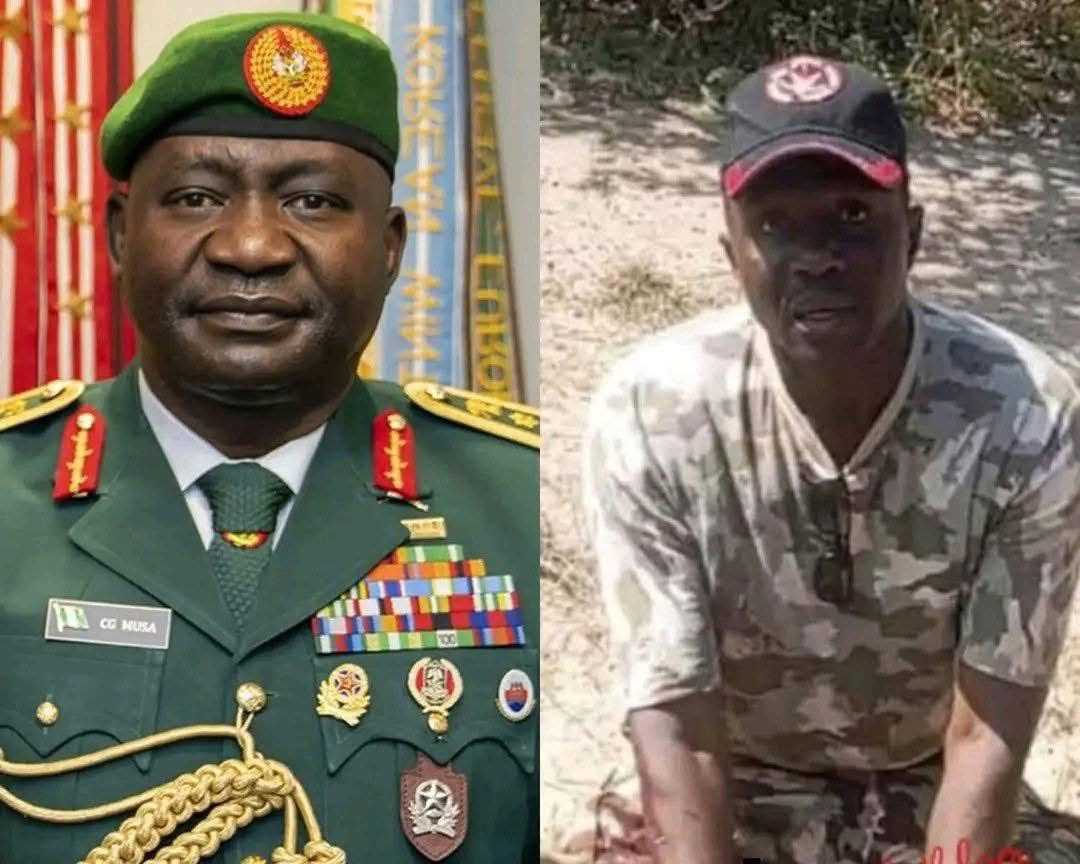
Minister for Defence, Gen Christopher Musa (retd) has said there were indications that the captured 25 Brigade Commander, Brig.-Gen. Musa Uba feared killed by terrorists in the North East might be alive.
He explained this during an interview on Channels Television’s Sunday Politics.
Brig.-Gen. Uba was captured by suspected Boko Haram/Islamic State West Africa Province (ISWAP) terrorists in November along Damboa–Biu axis after leading his team on an operation against the criminals.
Initial reports indicated that Uba successfully escaped from an ambush that reportedly killed his troops, took cover and was communicating his location with air support forces before the terrorist got to him.
Confirming they had gotten him, the criminals released a video footage of the Brigade Commander where he was reportedly killed.
But during the interview, the Defence Minister said they were still working on the probability that he was alive.
“Usually, they leave the bodies of those they killed for troops to recover them but in the case of Brig-Gen Uba, there has been no trace,” said the Minister.
He added that there were rumours Uba could be alive, adding that the military was investigating it to ensure his safe rescue from the terrorists.
The minister also decried what he described as a failure of strategic communication, saying a handful of individuals project negative images of Nigeria globally while the country neglects to celebrate its many achievers across different fields. According to him, the silence around positive stories creates space for damaging narratives to thrive.
On defence partnerships, Musa said Nigeria was prioritising capacity building through technology transfer, co-production and training rather than outright equipment purchases.
He said intelligence sharing with partners was being strengthened to address terrorism financing, logistics and command structures, stressing that real-time intelligence is critical in asymmetric warfare where enemies often blend with civilians.
Musa further identified poor infrastructure, difficult terrain and the threat of improvised explosive devices (IEDs) as major challenges confronting troops, explaining that military operations are often slowed by the need to avoid civilian casualties.
He said efforts were ongoing to improve mobility, surveillance and rapid response through helicopters, drones and specialised vehicles. He added that training and maintenance arrangements were being put in place ahead of new deployments.
On border security, Musa said Nigeria was reviewing multiple options, including technology-driven surveillance and physical barriers in critical areas, noting that effective border control requires data integration and collaboration among defence, interior and foreign affairs institutions.
He stressed that Nigeria’s non-aligned status allows it to partner with diverse countries in its security efforts, adding that a holistic national database and centralised coordination are essential to tackling security threats.
Musa assured Nigerians that progress was being made, urging sustained public support for the Armed Forces. “If Nigeria fails, everyone fails,” he said, calling on citizens to stand together in safeguarding the nation. (Culled from The Nation, except headline)