

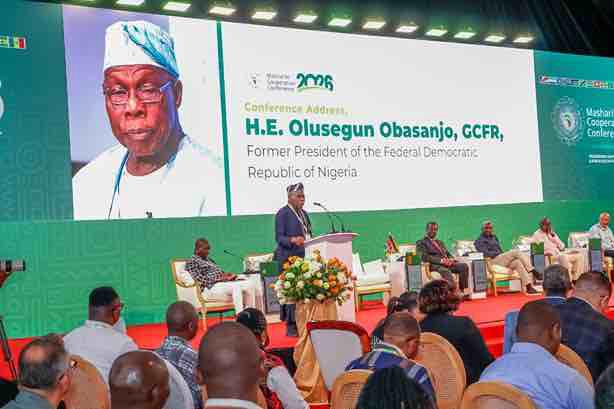
DIANI, Kenya — Former Nigerian President Olusegun Obasanjo delivered a sharp critique of African intelligence services on Thursday, warning that the “misinterpretation and misapplication of intelligence is always disastrous” and pointing to Iraq, Sierra Leone, and potential miscalculations regarding Iran as sobering examples.
Speaking at the Mashariki Cooperation Conference III, the veteran leader said the intelligence failure at the heart of Sierra Leone’s civil war was not a failure of information gathering but a “failure of political analysis.” He recalled that mediators were persistently unwilling to assess accurately what the Revolutionary United Front (RUF) was — a criminal enterprise that used revolutionary language to justify systematic mutilation, abduction, and terrorisation of civilians.
“They used power for impunity and recklessness,” Obasanjo said.
The former president, who has mediated conflicts in Burundi, the DRC, Zimbabwe, Sudan, and elsewhere over four decades, said intelligence is “indispensable to conflict prevention” but “woefully underused” for that purpose. In nearly every conflict he helped mediate, warning signs were visible months or years before the first shot was fired — ethnic tensions deliberately inflamed, youth recruited into militias, regional neighbours taking sides.
“The information existed,” he said. “What was missing was the institutional will to act on it, to share it across borders, and to take the political risks that early intervention requires.”
Obasanjo also issued a cryptic but pointed warning about international threat assessments. “Is Iran a true, genuine and serious threat to the US? I leave that to you,” he told the intelligence chiefs. He contrasted this with the disastrous intelligence used to justify the Iraq war. “We saw it in Iraq.”
He urged African intelligence services to become “more explicitly and systematically focused on early warning and early action,” and to build genuine cross-border trust through professional standards and institutional integrity.
“The failure of intelligence can be a disaster for the giver, the receiver, and beyond,” he said.
The Masharaki Cooperation Conference 111 is geared towards critically examining the evolving geopolitical dynamics shaping Africa’s security environment and exploring innovative approaches to strengthening the continent’s security architecture.
Kenya’s National Intelligence Agency is hosting the Mashariki Cooperation Conference 2026 in Diani, Kenya. It brought together more than 80intelligence chiefs from Africa, the Caribbean and other delegations
Specific objectives include discussing the emerging geopolitical shifts and their implications for Africa’s security landscape, evaluating the strengths, gaps, and prospects of Africa’s security architecture and promoting regional cooperation, intelligence sharing, and strategic partnerships to enhance collective security across the continent.
The 2026 Conference is the third year. It examined the current structure and effectiveness of Africa’s security architecture, assessedAfrica’s strategic preparedness and responses tocurrent geopolitical realities, and explored how Africa can leverage rapid technological advancements to support governance and security structures.
The intelligence chiefs also assessed Africa’s counterterrorism measures in the dynamic and changing terrorism theatre and examined Africa’s strategic responses to global resourcecompetition and climate change.
The organisers said the MCC offers an opportunity to mainstream African perspectives into global security dialogues at a time of rapid change, with profound implications for Africa’s security and prosperity. It also provides an opportunity for closer intra-African collaboration and enhanced engagement with global partners, benefiting the continent.