
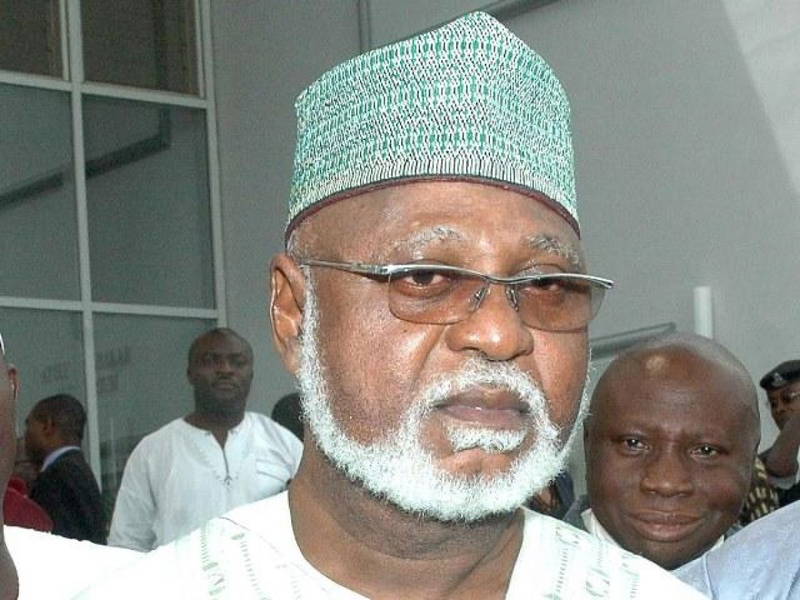
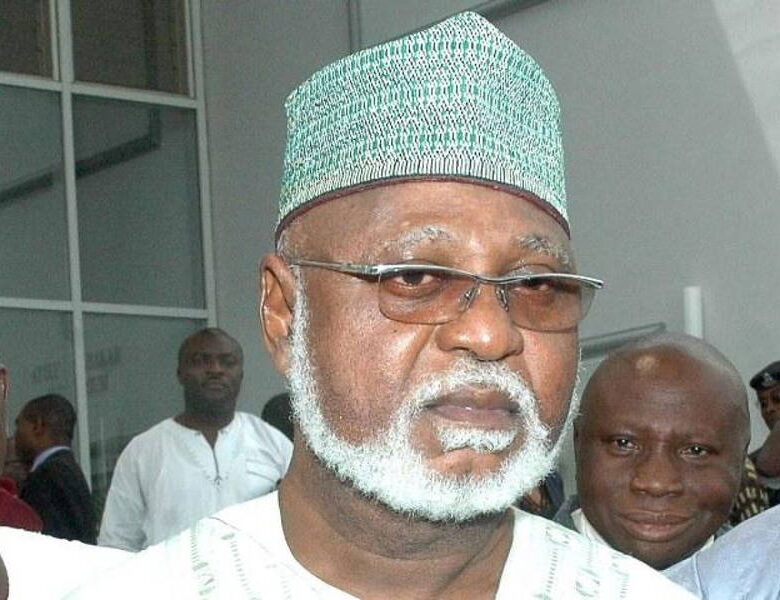
Former Head of State, General Abdulsalami Abubakar, has revealed that a series of unusual events in the hours preceding the death of General Sani Abacha on June 8, 1998, led him to suspect that “something was wrong.”
Abubakar disclosed that he and the then Chief of Army Staff, Lieutenant-General Ishaya Bamaiyi, were unknowingly locked inside a waiting room at the Presidential Villa for nearly an hour before being informed of Abacha’s death.
The revelations are contained in Chapter 19 of his 264-page autobiography, Call of Duty, which was publicly presented alongside two other books at the Presidential Villa, Abuja, on Saturday. The event formed part of activities marking Abubakar’s 84th birthday and was attended by President Bola Ahmed Tinubu, represented by Vice President Kashim Shettima.
The Morning That Changed Everything
According to Abubakar, the events of June 8, 1998, began with an early morning telephone call while he awaited instructions regarding his future in the military after 35 years of service.
He recalled that he had been expecting an assignment from General Abacha and initially feared he would be deployed to Togo for an ECOWAS summit.
“I quietly prayed that he would not send me to Togo. I was tired of travelling everywhere,” he wrote.
A subsequent call informed him that the Head of State wished to see him immediately. Owing to the urgency of the request, he left home in a tracksuit and slippers rather than his military uniform and proceeded directly to the Presidential Villa.
Upon arrival, however, he was informed that Abacha was not in his office.
Suspicious Developments at the Villa
Abubakar recounted that the circumstances that followed struck him as highly unusual.
After waiting for approximately thirty minutes, he attempted to proceed upstairs to see the Head of State. However, a security officer informed him that Abacha had instructed that he remain in the waiting room.
Shortly thereafter, Major-General Ishaya Bamaiyi joined him.
“We waited for about an hour. I decided to go and see Abacha by any means because I could not understand why we should be kept waiting for that long,” he recalled.
It was only later that both men realized the waiting room had been locked from the outside.
“I asked Bamaiyi if he was aware that we had been locked inside. Something kept telling me that something was wrong, but I could not place a finger on it,” Abubakar wrote.
Coomassie Breaks the News
The situation became clearer when the then Inspector-General of Police, Ibrahim Coomassie, arrived and opened the door.
According to Abubakar, Coomassie simply instructed them to follow him. As they walked toward the office, Abubakar remarked that he had been informed Abacha was at the residence.
It was at that point that Coomassie delivered the shocking news.
“He informed me that Abacha was dead. I was stunned and immediately asked what had happened, but he insisted that we proceed first,” he wrote.
Upon reaching the residence, Abubakar requested to see the late Head of State’s body.
“I entered the room, removed the covering, and saw him. I was shocked by the sudden development. I prayed for him and left the room,” he recalled.
Focus Shifts to Succession
Abubakar said senior government and military officials soon gathered at the residence, including Abacha’s Chief Security Officer, Major Hamza Al-Mustapha, former Secretary to the Government of the Federation, Babagana Kingibe, and then Chief Justice of Nigeria, Justice Muhammadu Uwais.
According to him, discussions quickly shifted from the circumstances of Abacha’s death to the question of succession.
The Chief Justice reportedly advised that a new Head of State should be appointed immediately to prevent a constitutional vacuum before the news was announced to the nation.
Abubakar alleged that members of what he described as Abacha’s “inner caucus” appeared more interested in determining the next leader than in making arrangements for the late ruler’s burial.
“They were more concerned about who would become the next Head of State. Bamaiyi and I were not expected to be part of the process, according to their plans,” he wrote.
A Tense Provisional Ruling Council Meeting
As Chief of Defence Staff and the most senior serving military officer following the removal of General Oladipo Diya, Abubakar chaired the meeting of the Provisional Ruling Council (PRC).
After changing into military uniform, he informed council members of Abacha’s death, the family’s desire to bury him in Kano, and the Chief Justice’s recommendation that a successor be chosen without delay.
The meeting, however, became increasingly contentious as members debated succession before burial arrangements.
“We were nowhere near reaching a conclusion. The discussions became heated, and some questioned why we were debating succession rather than proceeding immediately with the burial,” he recalled.
Eventually, members agreed to suspend deliberations, travel to Kano for the burial, and reconvene afterward.
Burial Trip and Alleged Succession Plot
Abubakar suggested that the trip to Kano may have been used by some individuals as an opportunity to advance succession plans in Abuja.
According to him, while senior officials travelled for the burial, efforts were allegedly underway to install an alternative candidate as Head of State.
He claimed that Admiral Mike Akhigbe, then Chief of Naval Staff, was being considered as a preferred successor, while Major-General Sarki Mukhtar, General Officer Commanding 1 Division, reportedly became aware of the unfolding developments and took steps to prevent what Abubakar described as “drama.”
“While we were in Kano, they were already preparing to swear in their preferred choice,” he wrote.
How He Emerged Head of State
Abubakar disclosed that the final contest for succession eventually narrowed to himself and Lieutenant-General Jeremiah Useni, who, although no longer actively involved in military affairs, remained one of the most senior officers in the country.
He also revealed that some influential figures had lobbied for Lieutenant-General Bamaiyi to become Head of State, but he declined to support such efforts.
Ultimately, the matter was decided through a vote among senior military officers.
“The contest was directly between Lieutenant-General Useni and me. I won the vote. That was how I became the 11th Head of State of Nigeria,” Abubakar wrote.
His account offers one of the most detailed insider narratives yet of the dramatic events that followed the sudden death of General Sani Abacha and ultimately paved the way for Nigeria’s transition from military rule to democratic governance.