
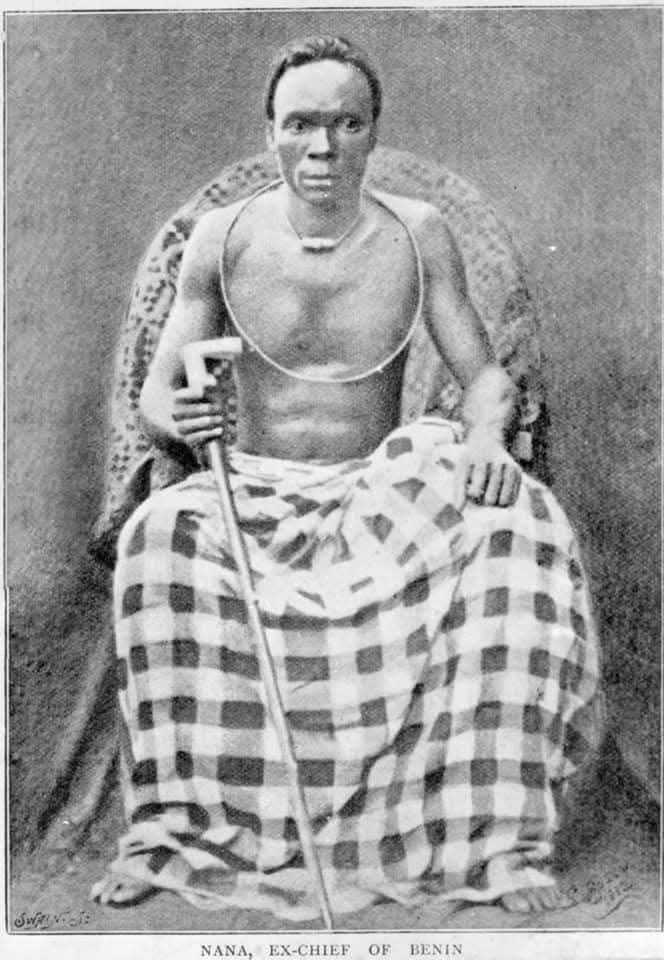
NANA OLOMU: THE ITSEKIRI CHIEF WHO STOOD AGAINST THE BRITISH EMPIRE

By Itse Ayonmike
I am Itse Ayonmike. I am from the Itsekiri tribe of the Niger Delta in southern Nigeria. This is not just Nigerian history. It is my ancestry.
Nana Olomu (1852–1916) was Governor of the Benin River and one of the wealthiest indigenous entrepreneurs of the nineteenth century, a palm oil magnate whose influence stretched across the Niger Delta. Even the British acknowledged his ability. Major Claude Macdonald, Commissioner for the Oil Rivers Protectorate, described him as “a man possessed of great power and wealth, astute, energetic and intelligent.”
The same colonial authorities later accused him of obstructing trade, inciting resistance, engaging in the slave trade, and practicing human sacrifice. Historians widely regard these charges as fabricated. His real offence was simpler. He stood in the way of British commercial and imperial ambition, and his power made him impossible to dominate.

In 1894, the British launched a military campaign against his stronghold at Ebrohimi. Nana evaded capture, refusing to let his people be slaughtered defending him. He later surrendered, was tried by a colonial court in Calabar, and was exiled to the Gold Coast. A man who commanded roughly 200 trade canoes, 100 war canoes, and as many as 20,000 fighting men chose the terms of his own downfall rather than watch Ebrohimi burn with his people inside it.
The arsenal the British seized after his surrender, cannons, hundreds of firearms, vast stores of ammunition, still stands as proof of the scale of what he built.
Nana was an African nationalist who refused to bow to British imperialism. For that, he had to be broken.
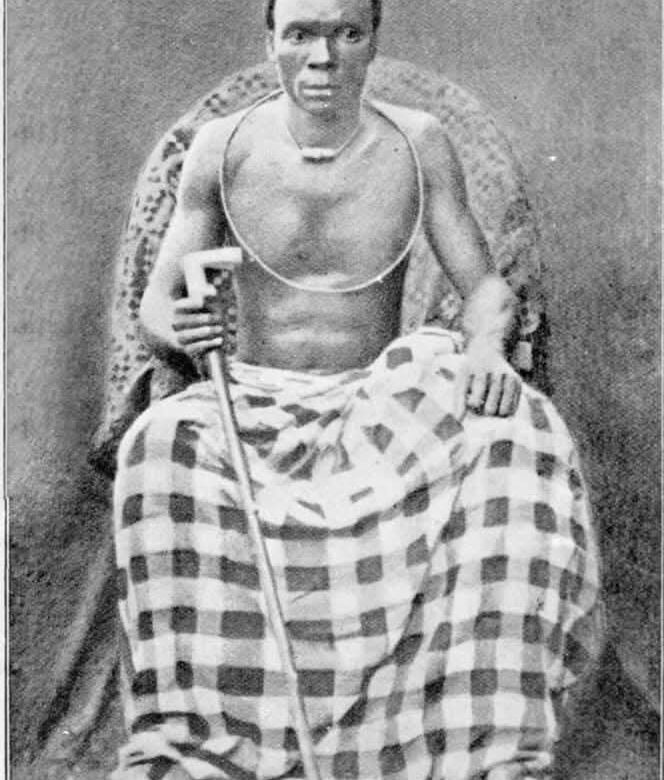
This story is personal. My aunt, who gave me the name Olagbara, is Nana Olomu’s granddaughter. His legacy is not just part of Nigerian history. It is part of my family history.