

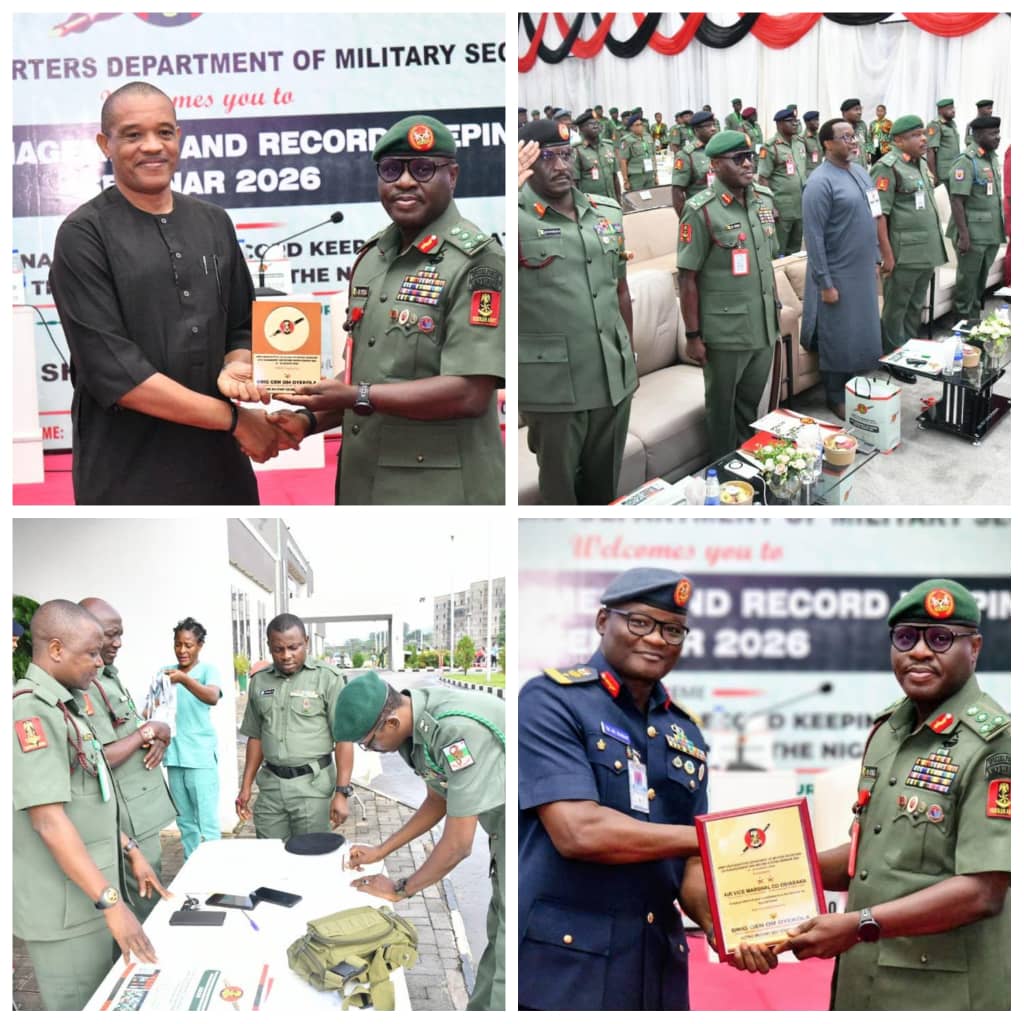
The Chief of Army Staff (COAS), Lieutenant General Waidi Shaibu, has identified effective data management and record-keeping as strategic capabilities essential to informed decision-making, operational effectiveness, accountability and the ongoing transformation of the Nigerian Army.
Shaibu made the assertion on Tuesday, August 18, 2026, while declaring open the fourth edition of the Army Headquarters Department of Military Secretary Data Management and Record-Keeping Seminar at the Armed Forces Officers’ Mess, Abuja.
The seminar, themed “Efficient Data Management and Record-Keeping: Imperative for Advancing the Transformation of the Nigerian Army,” brought together military personnel, academics and other resource persons to examine contemporary approaches to managing, securing and preserving critical institutional information.
Represented by the Dean, Faculty of Combat Arms Research, Nigerian Army Heritage and Future Centre, Major General Eyitayo Oyinlola, the COAS noted that although considerable attention is devoted to force structure, equipment acquisition and training, the effectiveness of these efforts ultimately depends on the availability of accurate, secure and timely information.
He stressed that decisions relating to recruitment, commissioning, postings, promotions, career progression, personnel welfare, logistics, force generation and operational planning are fundamentally dependent on the quality, integrity and accessibility of relevant data.
According to him, the rapidly evolving security environment, coupled with technological advancement and increasing reliance on digital systems, requires the Army to move beyond traditional approaches to record-keeping.
He therefore called for integrated, secure and technology-enabled systems capable of promoting efficiency, interoperability and institutional resilience.
Shaibu also urged Army personnel to strengthen their capacity in data governance, cybersecurity, records preservation and information assurance, stressing that data management and record-keeping are collective institutional responsibilities requiring discipline, professionalism and accountability at every level of command.
He charged participants to use the seminar to deepen their knowledge, exchange ideas and translate lessons learnt into measurable improvements across their formations, units and establishments.
The COAS commended the Department of Military Secretary for organising the seminar, describing it as timely and relevant to strengthening the Army’s institutional processes.
He also expressed appreciation to President Bola Ahmed Tinubu, the Commander-in-Chief of the Armed Forces, for his sustained commitment to the transformation and modernisation of the Nigerian Army.
Shaibu said the President’s strategic leadership and support had continued to enhance operational capabilities, equipment modernisation, personnel welfare and institutional reforms across the Service.
Earlier, the Acting Military Secretary (Army), Brigadier General Mathew Oyekola, described efficient data management and record-keeping as indispensable to sound administration, institutional memory and operational effectiveness.
Oyekola said the seminar aligned with the COAS Command Philosophy of “Advancing the Transformation of the Nigerian Army into a More Professional, Adaptable, Combat Ready and Resilient Force Capable of Decisively Discharging its Constitutional Responsibilities Within a Joint and Multi-Agency Environment.”
He noted that the transformation of a modern military institution depended significantly on the quality, accuracy, security and accessibility of its information assets.
According to him, effective data and records management provides the foundation for credible decision-making, career management, operational planning, logistics support, legal compliance, financial accountability and institutional continuity.
The Acting Military Secretary said the seminar was designed to equip participants with the knowledge and skills required to implement efficient, secure and standardised data management and record-keeping practices.
He urged personnel to promote a culture that prioritises accuracy, timeliness, accountability and strict compliance with established Standard Operating Procedures, noting that every report generated and personnel record maintained contributes to preserving the institutional memory of the Nigerian Army.
Delivering the keynote lecture, titled “Efficient Data Management and Record Keeping: A Catalyst for Enhancing Career Management and Administration in the Nigerian Army,” Major General Nosakhare Ugbo (rtd.) said modern career management could no longer rely on manual and fragmented systems.
Ugbo maintained that accurate and reliable data directly affects recruitment, commissioning, postings, promotions, courses, appointments, welfare and retirement benefits.
He urged personnel to embrace technology-driven solutions, comply with established procedures and treat accurate record-keeping as a professional responsibility.
The retired general also advocated sustained investment in data governance, cybersecurity and capacity development to strengthen personnel administration and enable the Nigerian Army to meet the demands of an evolving security environment.
The seminar featured lectures and interactive discussions by military and academic resource persons, with focus on data governance, cybersecurity, digital records management, information assurance, records preservation and contemporary best practices for improving career management and administration in the Nigerian Army.
The statement was signed by Colonel Appolonia Anele, Acting Director, Army Public Relations, on August 18, 2026.