
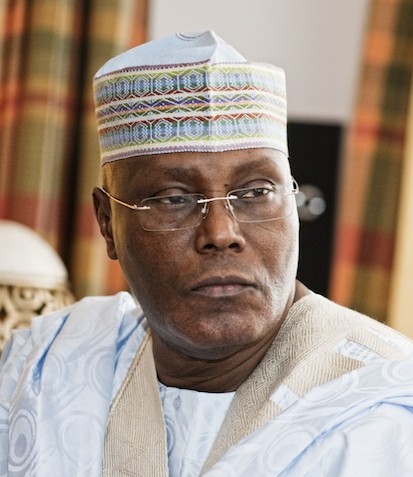
The Presidency has accused former Vice-President Atiku Abubakar of inconsistency over his position on petrol subsidy, describing his latest comments as evidence that he is “simply playing politics” with the economic difficulties facing Nigerians.
In a statement issued on Wednesday, the Special Adviser to the President on Information and Strategy, Bayo Onanuga, said Nigerians had heard three different explanations of what an Atiku administration would do about petrol subsidy within one week.
According to Onanuga, Atiku’s spokesperson, Paul Ibe, initially said the former vice-president would restore petrol subsidy if elected president and later phase it out as a temporary intervention to enable Nigerians and businesses recover.
He said another senior aide, Phrank Shaibu, subsequently described Ibe’s position as an “unauthorised and misleading characterisation” of Atiku’s policy, explaining that subsidy would remain until domestic refining expanded, supply stabilised, competition deepened and market conditions allowed affordable prices without government support.
However, Onanuga said Atiku later intervened and reaffirmed that his position had not changed, insisting that he would restore what he described as a “targeted subsidy” and put purchasing power back in the hands of Nigerians.
The presidential aide argued that the conflicting statements amounted to a serious policy contradiction.
“Nigerians deserve clarity, not policy by trial and error,” Onanuga said.
He also challenged Atiku’s argument that petrol subsidy would make fuel and transportation cheaper and consequently reduce food prices, noting that several factors contribute to food inflation.
According to him, agricultural productivity, insecurity, exchange rates, logistics, storage, flooding, input costs, money supply and supply constraints also influence food prices.
Onanuga maintained that petrol prices alone could not explain Nigeria’s food inflation, arguing that Nigerians experienced rising food prices even during the years when petrol subsidy was in place.
He said the administration of President Bola Ahmed Tinubu had been addressing the broader economic challenges rather than reducing the cost-of-living crisis solely to petrol prices.
The Presidency challenged Atiku to provide details of his proposed “targeted subsidy”, including its cost, beneficiaries, funding mechanism and the economic conditions that would determine when it would be terminated.
“Either he has a coherent, costed, and workable petroleum policy, or he is simply playing politics with a policy that has significantly restored fiscal health to the three tiers of government and stabilised the macroeconomic environment,” Onanuga said.
The presidential aide also questioned the former vice-president’s proposal to link subsidy to the price of crude oil, arguing that crude oil refining produces several other petroleum products apart from petrol.
Onanuga cited diesel, aviation fuel, kerosene, petrochemical feedstocks, asphalt, hydrocarbon gas liquids, lubricants, waxes, petroleum coke and sulphur among the products derived from crude oil.
He noted that diesel accounts for roughly 25 per cent of a barrel’s output, while jet fuel and kerosene account for about nine per cent, according to the figures contained in the statement.
He further recalled that diesel was deregulated in 2004 during the Obasanjo-Atiku administration, while kerosene and jet fuel were deregulated at later dates.
Onanuga therefore questioned whether an Atiku administration would extend subsidies to other products derived from crude oil, particularly diesel and kerosene, which are used by households, businesses and transport operators.
He also raised concerns about the potential impact of supplying discounted crude oil to domestic refineries while subsidising only petrol.
“Will he allow the refineries he will supply discounted crude oil to profit from 55 per cent of the by-products, while focusing subsidy only on petrol, his obsession?” he asked.
The Presidency concluded by accusing Atiku of lacking clarity in his proposed policy and urged him to provide Nigerians with a comprehensive explanation of how his subsidy plan would work.
The statement was signed by Bayo Onanuga, Special Adviser to the President on Information and Strategy, on August 26, 2026.