

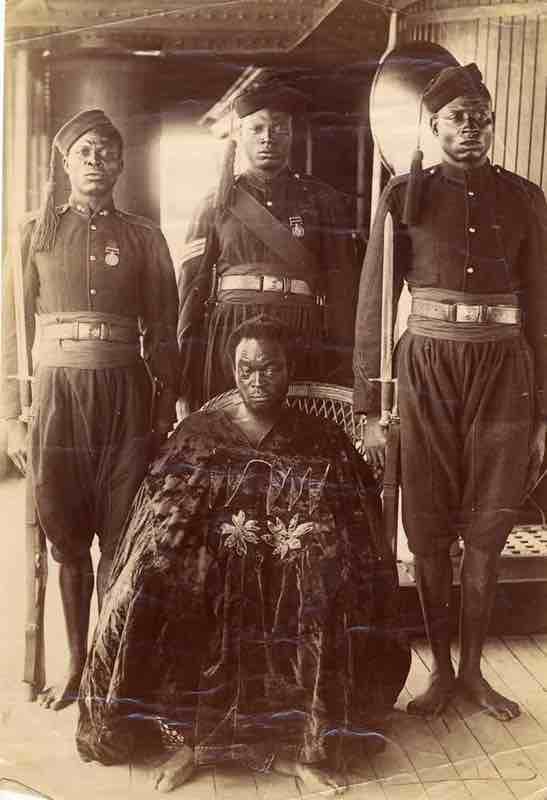
This image of Ọba Ovọnramwẹn Nọgbaisi in captivity, guided by soldiers, depicts his subjugation after the British punitive expedition of 1897. It shows him detained on a British ship (the S.S. Ivy) during his forced exile to Calabar, a humiliating display meant to symbolize the end of an independent Benin Kingdom. The night before, he was reported to have been restrained in a hammock, strapped in as he got understandably agitated. Some accounts say he was gagged on his way out of the city to prevent any row.

The king could have been spared from this treatment but the British officials worried about his subjects. For a people who see their king as God and who are used to swearing oaths and curses such as ‘Ọba gha gbuẹ!’ meaning ‘May the Oba kill you!’, removing the king from the land became necessary to show the people the uselessness of resistance to British fire power.

What many do not realize is that several West African kingdoms confronted by the British imperial army saw their monarchs spared deposition—some continued to reign, and others like King Nana, the Itsekiri ruler, were later restored to their thrones under colonial rule. Yet history records that Ovonramwen’s case unfolded differently, not through much of his personal failing, but largely because of the actions of his own subjects which created the tragic circumstances that led to his removal, banishment, and exile.
Benin royal historian, Jacob Egharevba’s narration of the last words of the Oba on his way to Calabar supports this reasoning:
“I appeal to the Almighty and the spirits of the departed Obas of Benin, my fathers, to judge between me and the Binis who ill-advised and cunningly sold me into the hands of the British troops in search of their own liberty and benefits”.
There are unsubstantiated accounts that say the Oba left with a curse, “Umaigba n’ Ẹdo” meaning there will never be peace or unity amongst the Benin people.
The fall and exile of Oba Ovonramwen remain one of the most important turning points in Benin history. His experience offers enduring lessons, not only for the people, but also for the great one who sits on the throne today. As echoes of the past reappear in our time, these lessons deserve fresh attention.
1. Every Monarch Needs Honest, Courageous Advisers
Ovonramwen was misled by advisers who encouraged confrontation instead of diplomacy. Their poor judgment helped draw Benin into a conflict it could not survive. No throne is strengthened by flattery or silence, only by counsellors who speak truthfully, boldly, and wisely.
2. Reverence Must Not Become Idolatory or Deification
In the late 19th century, Benin people elevated the Oba to divine status, cutting him off from the reality around him. He stepped out of the palace only twice a year. Today, some overzealous royalists and supporters risk repeating this error, shielding the monarch from constructive feedback and mistaking cultural reverence for absolute political authority, in a constitutional democracy.
3. Leadership and People Must Understand the Political Moment
Ovonramwen underestimated how radically the political world had shifted. Tradition, custom and rituals could not protect the kingdom. Today, cultural authority works hand-in-hand with constitutional realities, national institutions, and a global governance system that demands clarity and balance.
4. The Past Is Echoing Again
Today the behaviour of some uninformed subjects around issues that relate to the palace – violent hostility to dissent, blind deification, and rejection of accountability – mirrors the very atmosphere that led to Ovonramwen’s downfall. In this day and age, we have people cursing their fellow citizens with “Ogun Ọba gha gbuẹ!” meaning “May the Oba’s god of iron strike you dead!”. Such attitudes do not protect the Benin monarchy; they expose it to avoidable risk.
The Benin monarchy has survived and will survive for centuries not by resisting change but by adapting wisely to it. To honour our heritage and safeguard the future, both the monarch and the people must embrace the lessons of Ovonramwen’s fate: seek wise counsel, welcome truth, understand the times, negotiate constitutionally, and resist the urge to repeat the patterns that once led to the kingdom’s humiliation. A stronger, more grounded Benin depends on remembering, so that history does not repeat itself.
Ọba ghatọ kpẹ e!!!
#beninhistory
Credit: Benin History Page on Facebook.