

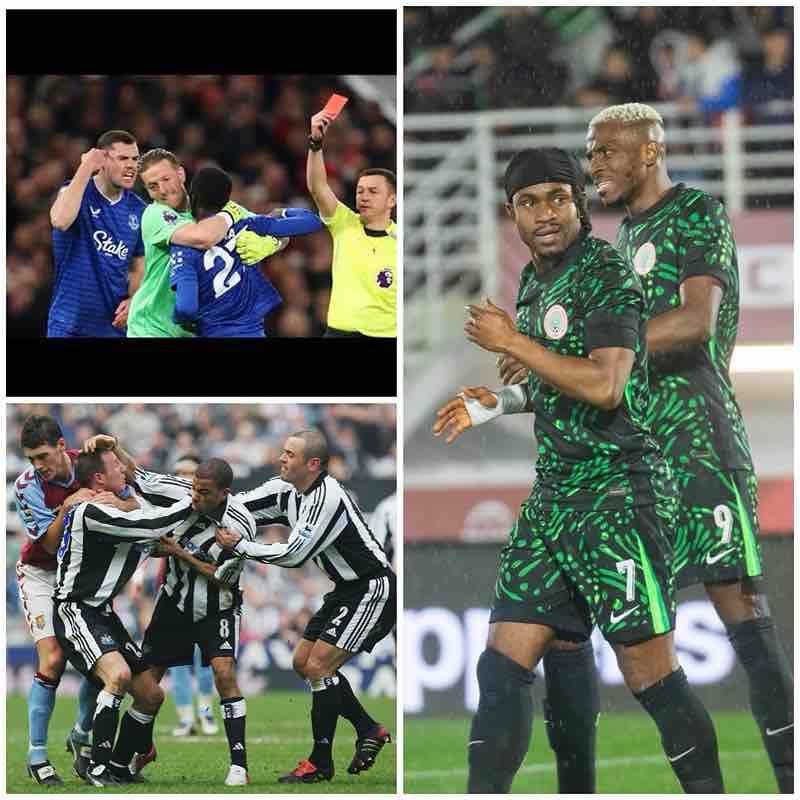
Football is an emotional game played at the highest level under intense pressure. Tempers flare, egos clash, and even teammates united by the same badge have occasionally crossed the line.

The recent incident involving Victor Osimhen and Ademola Lookman during Nigeria’s AFCON Round of 16 clash against Mozambique sparked widespread debate among fans and the media.

While the moment drew heavy criticism, history clearly shows that such situations though regrettable are far from uncommon in football.
The incident occurred in the 63rd minute, with Nigeria already leading 3–0 in a match the Super Eagles dominated from start to finish, eventually winning 4–0. With the game firmly under control, Osimhen grew visibly frustrated after being overlooked several times by teammates despite being clear on goal. One such moment involved Lookman, who chose to dance through the Mozambique defence rather than square the ball, denying Osimhen a clear opportunity to complete his hat-trick.
Osimhen reacted by gesturing toward his teammate and repeatedly emphasizing that it was a “team game.”
That brief exchange quickly became a talking point, with sections of Nigerian fans and media shifting focus away from the emphatic victory to question Osimhen’s attitude. However, context is crucial. Ademola Lookman had earlier provided the assists for Osimhen’s two goals, highlighting the strong attacking understanding between both players. Nigeria’s attacking display was fluid, clinical, and effective everything a coach would demand at the knockout stage of a major tournament.
What played out on the pitch was frustration, not insubordination or hostility. Strikers thrive on goals, and emotions naturally rise when personal milestones such as a tournament hat-trick, golden boot are within reach. Such reactions, while not ideal, are a by-product of elite-level competition.
Importantly, football history is filled with far more severe teammate clashes involving some of the game’s biggest names.
On 2 April 2005, Newcastle United teammates Lee Bowyer and Kieron Dyer famously exchanged punches on the pitch during a 3–0 defeat to Aston Villa at St James’ Park.
In November 2010, AC Milan teammates Zlatan Ibrahimović and Oguchi Onyewu were involved in a violent training-ground confrontation that reportedly left Onyewu injured.
In January 2013, Manchester City manager Roberto Mancini was forced to physically restrain Mario Balotelli during a heated training session.
At Bayern Munich in April 2012, Arjen Robben and Franck Ribéry were involved in a public argument during halftime of a UEFA Champions League semi-final against Real Madrid. The disagreement over who should take a free-kick escalated into a physical confrontation in the dressing room, resulting in fines but ultimately strengthening their bond.
Another notable example came in July 2020, when Tottenham Hotspur teammates Hugo Lloris and Son Heung-min were involved in a heated exchange during a Premier League match against Everton. Lloris angrily confronted Son at halftime for failing to track back defensively, with the argument continuing as both players walked off the pitch. Despite the visible tension, Tottenham responded positively in the second half and went on to win the match 1–0, with both players later downplaying the incident as a moment of passion and accountability.
More recently, Idrissa Gueye was sent off for striking his own teammate Michael Keane during an Everton match. None of these incidents defined the players’ careers or permanently damaged their teams.
Against that backdrop, the Osimhen, Lookman exchange appears minor.
There was no physical altercation, and no lasting disruption to team harmony. Nigeria went on to score four goals, keep a clean sheet, and book a place in the next round clear indicators of unity and focus.
At major tournaments like the Africa Cup of Nations, pressure is magnified. National pride, expectations from millions of fans, and personal ambition all collide within 90 minutes. Players are not robots; they are competitors driven by passion. While professionalism demands composure, it also allows room for human emotion.
Rather than amplify division, Nigerian football stakeholders fans, media, and analysts alike would do well to strike a balanced tone. Constructive criticism is part of sport, but disproportionate outrage risks overshadowing performance, progress, and results.
Victor Osimhen remains one of Africa’s most committed and prolific forwards, while Ademola Lookman continues to be a key creative force for the Super Eagles. Their connection on the pitch produced goals, dominance, and victory and ultimately, that is what matters most.
Football will always have moments of tension. What defines great teams is not the absence of such moments, but how quickly they move past them together.
Credit: Contributor at FAKSMEDIA WhatsApp Group.