

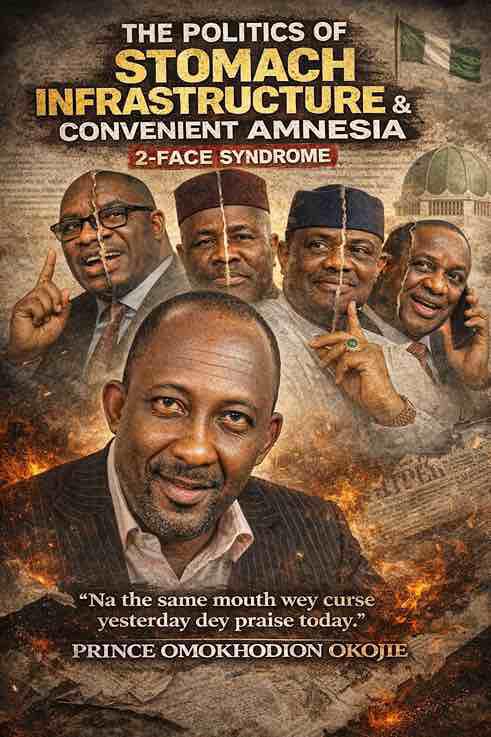
By Prince Omokhodion Okojie

There is a proverb from the old village square that says:
“When a man says what he did not say yesterday, the elders will bring out the calabash of memory.”

Nigeria is gradually becoming a country where that calabash of memory must constantly be brought out.
Because many of those who occupy the corridors of power today speak as if Nigerians have forgotten yesterday.
The recent interview involving Daniel Bwala, now one of the public defenders of President Bola Ahmed Tinubu, has again reminded Nigerians of a troubling habit in our politics.
A habit of political transformation that happens overnight.
A habit where critics suddenly become defenders.
A habit where yesterday’s thunder becomes today’s whisper.
And as Nigerians would say in pidgin:
“Na the same mouth wey curse yesterday dey praise today.”
THE INTERVIEW THAT EXPOSED A BIGGER PROBLEM
When Daniel Bwala was confronted with his past criticisms of Tinubu during a recent television interview, many Nigerians expected him to simply explain his change of position.
After all, people can change their minds. Politics allows for that.
But the real shock came when he appeared to distance himself from statements that were already on record.
That moment was uncomfortable.
Not just for Bwala.
But for the entire political culture that produced such a moment.
Because Nigerians watching that exchange were not merely seeing a man struggling with his past.
They were seeing the face of political convenience.
And the streets reacted in their usual blunt way:
“Oga, no be we dey mad. Na una think say we no get memory.”
NIGERIA’S GROWING INDUSTRY OF POLITICAL AMNESIA
If Daniel Bwala were the only example, Nigerians might laugh and move on.
But the truth is that Nigeria’s political space is now filled with men and women who have performed similar gymnastics.
Let us look at a few.
NYESOM WIKE
Before the 2023 elections, Nyesom Wike was a leading figure in the opposition PDP.
He attacked the ruling APC with relentless energy.
Yet today he sits comfortably in Tinubu’s cabinet as Minister of the Federal Capital Territory.
In politics, alliances change. That is normal.
But what Nigerians struggle with is the speed with which yesterday’s accusations disappear.
As the pidgin proverb goes:
“If goat follow tiger waka, e better make e forget say him be goat.”
FESTUS KEYAMO
Festus Keyamo was once one of the fiercest critics of certain political figures before later aligning fully with the APC government.
Today he is a central voice defending the administration.
Again, alignment is not the issue.
But Nigerians remember the sharp contrast between past rhetoric and present loyalty.
FEMI FANI-KAYODE
Few political journeys in Nigeria illustrate dramatic transformation like that of Femi Fani-Kayode.
There was a time when his criticism of the APC was volcanic.
Yet he later appeared smiling with the very leadership he once condemned.
The streets summarized it better than political analysts ever could:
“When food don ready, enemy fit become brother.”
THE ROOT OF THE PROBLEM: STOMACH INFRASTRUCTURE
There is a phrase Nigerians now use frequently.
Stomach infrastructure.
It refers to a politics driven not by ideology or national vision but by personal benefit.
In such a system, loyalty is not anchored on principle.
It is anchored on opportunity.
When opportunity moves, loyalty follows.
In pidgin language, the explanation is even simpler:
“Where food dey, crowd go gather.”
That is why Nigerian political defections rarely come with serious policy arguments.
You rarely hear a politician say:
“I joined this government because its economic framework is stronger.”
Instead, what Nigerians see is sudden political romance.
Yesterday’s enemy becomes today’s ally.
Yesterday’s condemnation becomes today’s praise.
A PARABLE FROM THE OLD FARMER
An old farmer once told his son a story.
A chameleon lived on a tree in the farmer’s compound.
Every morning the chameleon changed colour.
Green in the morning.
Brown in the afternoon.
Yellow in the evening.
The young boy asked his father why the chameleon kept changing colour.
The old man replied:
“My son, the chameleon changes colour not because it loves the tree, but because it loves survival.”
That story explains much of Nigerian politics today.
Many politicians do not change positions because they discovered new truths.
They change positions because they discovered new opportunities.
THE COST TO NIGERIA
The greatest casualty of this political culture is public trust.
When politicians easily abandon yesterday’s convictions, citizens begin to doubt everything they hear.
Campaign speeches begin to sound like rehearsed theatre.
Political debates become entertainment.
And democracy slowly loses credibility.
A country cannot build strong institutions if its leaders treat truth like a disposable commodity.
WHAT NIGERIANS MUST BEGIN TO DO
Nigerians must develop a habit stronger than political speeches.
That habit is collective memory.
Every interview should be remembered.
Every statement should be archived.
Every promise should be revisited.
When politicians know that the public remembers, they will become more careful with their words.
Because the Nigerian street has already learned a powerful lesson.
As the elders say:
“The mouth that speaks carelessly will one day explain itself before the crowd.”
A WORD TO POLITICIANS
Changing political alliances is not a crime.
Politics evolves. Circumstances change.
But honesty must remain constant.
If a politician changes his mind, he should simply say:
“I have changed my position because of these reasons.”
That honesty will earn respect.
But denying yesterday’s words when the evidence exists only deepens public distrust.
FINAL REFLECTION
Nigeria is too important to be reduced to a theatre of convenient memory.
Our country deserves leaders whose words have weight.
Leaders whose convictions are not for sale.
Leaders who can stand by what they said yesterday even while navigating today.
Until then, Nigerians will continue to watch the political stage with a mixture of frustration and humour.
And from the roadside you will keep hearing that familiar pidgin sentence:
“Politics for this country be like Nollywood film. Every week, new episode.”
But Nigeria is not a movie.
It is a nation of over two hundred million people whose future cannot depend on political actors who change scripts whenever the camera turns.
And so the calabash of memory remains on the village square.
Waiting.
Because sooner or later, every politician must drink from it.
Prince Omokhodion Okojie writes from Benin City.