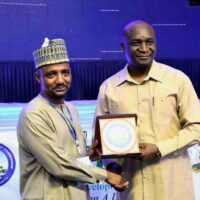


On the evening of April 2, 2026, within the historic halls of King’s College in London, the spotlight turned firmly on Nigeria as the Minister of Interior, Olubunmi Tunji-Ojo, was conferred with the Personality of the Year Award by Triangle International Magazine at the African Leadership Awards. It was not merely a ceremonial recognition. It was a moment that captured a broader story of leadership, reform, and a renewed connection between governance and the everyday lives of citizens.

The honour reflects a growing consensus both at home and across the diaspora that Tunji-Ojo represents a new archetype of public leadership in Nigeria, one defined not by rhetoric but by measurable impact. In less than two years in office, he has become one of the most visible faces of President Bola Ahmed Tinubu’s Renewed Hope Agenda, translating policy ambition into tangible outcomes that Nigerians can see, feel, and experience.

What has distinguished Tunji-Ojo in the eyes of many Nigerians is his ability to bridge the gap between institutional reform and human experience. Across airports, identity centres, correctional facilities, and emergency response systems, there is a noticeable shift in how government services are delivered. Processes that once symbolised frustration have been reengineered into systems that prioritise speed, dignity, and efficiency. For millions of Nigerians who interact daily with these services, this transformation has not gone unnoticed.
At the centre of this shift is a leadership style that combines technical depth with an unusual attentiveness to public needs. The introduction of integrated digital infrastructure such as the Centralised Interior Management and Administration System has quietly redefined how agencies communicate and operate. While the technology itself is complex, its impact is simple and profound shorter waiting times, fewer bureaucratic hurdles, and a level of coordination that was previously absent. Nigerians in the diaspora, who often engage with immigration and identity systems from afar, have been particularly vocal in acknowledging these improvements, describing a system that now feels responsive rather than distant.
Beyond systems and structures, Tunji-Ojo’s reforms have carried a strong human element. His approach to correctional services, for instance, has resonated deeply with a public long concerned about the conditions within custodial centres. By prioritising rehabilitation, education, and welfare, he has helped reposition the correctional system as a space not just of confinement but of transformation. Stories of inmates acquiring education and skills have travelled far beyond prison walls, reinforcing a broader message that governance can be both firm and compassionate.
This balance between discipline and empathy has also shaped his work in security and civil defence. By strengthening the capacity of agencies to protect critical infrastructure, combat illegal activities, and safeguard communities, he has contributed to a growing sense of order and accountability. Yet, this has been done alongside efforts to improve staff welfare, promote professionalism, and restore morale within the services. The result is a system that not only performs better but is also driven by personnel who feel valued and motivated.
For Nigerians living abroad, the recognition in London carried additional symbolism. It affirmed that the changes unfolding within Nigeria’s Ministry of Interior are visible on the global stage. Many in the diaspora, who often serve as informal ambassadors of the country, have found renewed confidence in speaking about Nigeria’s progress. The modernization of passport services, the reduction in processing delays, and the introduction of more user-friendly systems have directly improved their interactions with Nigerian institutions, strengthening a sense of connection that had, for years, been strained.
Tunji-Ojo’s emergence as a widely respected figure also speaks to his personal disposition as a public servant. His leadership has been marked by accessibility, clarity of vision, and a consistent emphasis on results. Rather than positioning himself above the system, he has worked within it to drive change, demonstrating that effective governance is rooted in service. This orientation has endeared him to many Nigerians who see in him a leader who listens, acts, and delivers.
The award at the African Leadership Awards therefore represents more than individual recognition. It is an acknowledgment of a broader shift in governance culture, one that prioritises efficiency, accountability, and citizen-centric service delivery. It underscores the idea that public office, when approached with purpose and discipline, can produce outcomes that restore trust and inspire confidence.
As the applause echoed through King’s College that evening, it carried with it the voices of countless Nigerians whose daily experiences have been improved by these reforms. It carried the hopes of a diaspora eager to see their country align with global standards. And it affirmed that leadership, when grounded in service, has the power to transform not just institutions, but the relationship between a government and its people.
In honouring Tunji-Ojo as Personality of the Year, Triangle International Magazine has, in effect, spotlighted a narrative of renewal. It is a narrative in which governance is no longer distant or abstract, but present, responsive, and human. It is a narrative that continues to unfold, with implications that extend far beyond a single ministry, shaping expectations for what public service in Nigeria can and should become.
Salako, a media consultant, writes from Lagos.