
By Chidi Omeje
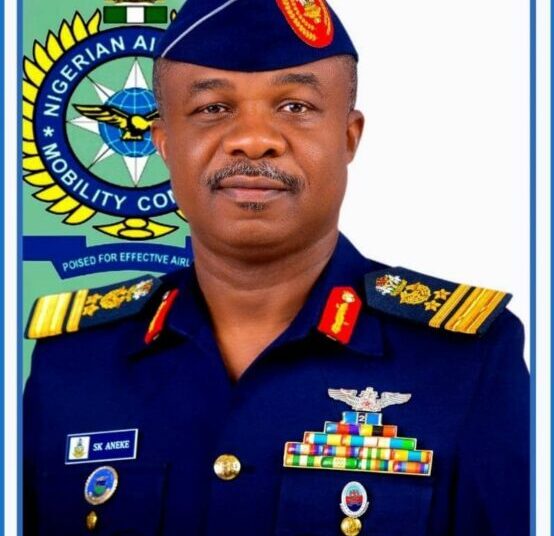
On the 24th of October, 2025, President Tinubu announced the appointment of new set of Service Chiefs. Among the appointees was a certain Air Vice Marshal Sunday Kelvin Aneke.
The appointments were subsequently ratified by the Senate and Aneke was promoted to Air Marshal and assumed office as the 23rd Chief of the Air Staff.
It was obvious that the desire for fresh ideas and new impetus in the protracted fight against terrorism, insurgency, banditry, militancy and sundry violent crimes that have assailed the country for too long, was what motivated the Commander-in-Chief to hire the new hands.
Considering that Boko Haram and ISWAP terror groups in the north east and terror bandits in north west and North Central regions are exploiting difficult terrain, mobility and dispersed networks to evade ground forces, air power is simply indispensable and Nigerian Air Force is fittingly willing, able and ready for the task that needed joint efforts.
Apart from the presidential brief handed over to the new service, to wit, stamp out banditry and terrorism, Air Marshal Aneke is fully aware that the expectations from Nigerians for a deserved respite were rising and that the demand for decisive air power was unmistakable. Inspired by the trust the President has in him and guided by the expectations of Nigerians, Air Marshal Aneke has so far put his right foot forward.
One hundred days on, his early moves point to a clear intent: restore combat effectiveness, sharpen operational focus, and reassert the NAF as a critical force in Nigeria’s fight against insecurity
While 100 days is an early milestone, it offers a useful lens through which to assess command priorities, operational direction and strategic intent. In this period, the NAF under Air Marshal Aneke has emerged as a central pillar of Nigeria’s counter-terrorism and counter-banditry efforts, delivering persistent air power across multiple theatres of operation.
A defining feature of Air Marshal Aneke’s first 100 days has been the consistency and reach of NAF air operations. Rather than episodic or reactive deployments, airstrikes during this period have been sustained, intelligence-driven and closely integrated with ground manoeuvres.
Across theatres including the North East, North West, North Central, and parts of the Niger Delta area East, NAF platforms have provided critical close air support, precision strikes, armed reconnaissance and air interdiction. Terrorist camps, logistics hubs, convoys and escape routes have been targeted, significantly degrading the operational capacity of insurgents and bandits.
Military analysts note that the sustained nature of these operations has reduced the ability of armed groups to regroup after initial losses. In several instances, airstrikes have preceded or complemented ground assaults, enabling troops to advance with reduced resistance while limiting casualties. Under Aneke’s leadership, the Air Force has reinforced its role as a force multiplier by consistently shaping the battlespace before, during and after ground engagements.
Beyond immediate tactical gains, the visible and persistent presence of NAF air assets has had a broader deterrent effect. Armed groups that once relied on mass movement and motorcycle-borne raids have been increasingly forced into smaller, fragmented units, wary of detection from the air. This shift has been particularly evident in bandit-dominated areas, where air interdiction has disrupted supply lines, denied safe havens and constrained mobility. The psychological impact of air power, often underestimated, has emerged as a key advantage as it reinforces state authority and reassuring affected communities.
Air Marshal Aneke’s command style, as reflected in the first 100 days, places strong emphasis on operational readiness, precision and professionalism. Sources within the Air Force describe a renewed focus on mission planning, maintenance discipline and pilot currency, aimed at ensuring that platforms are not only available but effective.
The CAS has consistently highlighted the importance of synergy with other services, particularly the Nigerian Army and intelligence agencies. This approach aligns with modern counter-insurgency doctrine, where air power is most effective when integrated into joint operations rather than deployed in isolation.
Perhaps the most strategically significant aspect of Air Marshal Kelvin Aneke’s early tenure is his clear push for capability enhancement and force modernisation. Recognising that Nigeria’s security threats are evolving, he has advocated the acquisition of more sophisticated platforms, including attack helicopters, unmanned aerial systems, and advanced surveillance assets. A few weeks ago, he led a high-level engagement in United States to accelerate the delivery of twelve AH-1Z attack helicopters to the Nigerian Air Force.
Such high-end platforms are critical for precision strikes, persistent intelligence, surveillance and reconnaissance (ISR), and rapid response across vast and often inaccessible terrain. Analysts argue that expanding the fleet of attack helicopters, in particular, would significantly enhance the NAF’s ability to support troops in close combat and conduct independent strike missions against fleeting targets. Aneke’s emphasis on modern platforms reflects an understanding that air superiority and situational awareness are central to defeating asymmetric adversaries who rely on concealment and speed.
As part of NAF’s fleet modernisation drive, Air Marshal Aneke, was also in Milan, Italy recently to engage Leonardo Aircraft Division on the M-346 fighter ground attack aircraft programme. The CAS described the programme as a critical leap in renewing the NAF’s combat capability, noting that the platform will strengthen precision strike operations, improve training outcomes, and reinforce Nigeria’s regional deterrence posture through carefully synchronised aircraft delivery and seamless induction into operational service.
Side by side operational demands, the CAS has also maintained a focus on training and safety, key pillars of sustainable air power. While the tempo of operations has increased, there has been no indication of compromise on air safety standards; this only points to a commitment to professionalism even under pressure. Of course the emphasis on training signals a long-term vision: building a force capable of sustaining high operational demands without over-reliance on a narrow pool of assets or personnel.
Another notable aspect of the NAF’s activities in the past 100 days has been improved public relations and strategic communication. Timely updates on air operations have helped counter misinformation while highlighting the role of air power in national security. The healthy relationship between NAF and the media which is being nurtured and supported by the CAS has also contributed a great deal in helping it to tell its story.
Even more impressive is NAF’s relationship with civilian population especially communities impacted by its operations. In a sustained effort to win the hearts and minds of the people it is serving, NAF under Air Marshal Aneke has initiated and commissioned a number of quick impact projects and programmes aimed at uplifting the lives of the people and impacting communities positively.
Accepting responsibility whenever there is an error in its operations is one thing that the NAF is respected for. A case in point is the 2024 Christmas Day incident in Silame Local Government Area of Sokoto State where erroneous airstrike claimed the lives of 12 innocent civilians. Rather than retreat into denial, deflection or bureaucratic silence, the NAF, under Air Marshal Aneke, chose an honorable path by accepting full responsibility and apologized to the community, admitting that it was a “grave operational mistake”. That was a commendable sense of institutional accountability.
Despite early successes, significant challenges remain. The high cost of advanced platforms, maintenance demands, and the need for continuous training will test the Air Force’s capacity in the months ahead. Moreover, adversaries are likely to adapt, seeking new methods to evade aerial surveillance and strikes. Sustaining momentum will require not only equipment acquisition but also institutional reforms, funding stability and continued inter-agency cooperation.
At the 100-day mark, Air Marshal Kevin Aneke’s tenure as the 23rd Chief of the Air Staff of the Nigerian Air Force, reflects a clear and assertive use of air power as a central instrument of national security. Through sustained airstrikes across multiple theatres, strengthened joint operations, a forward-looking push for modern combat platforms, and a healthy relationship with civil population, the Nigerian Air Force under his leadership has reinforced its relevance in Nigeria’s fight against terrorism and banditry.
While it is too early for final judgments, the first 100 days point to a leadership determined to sharpen the NAF’s combat edge and position it for the complex security challenges ahead. As operations continue and modernisation efforts unfold, air power is likely to remain a decisive factor in Nigeria’s evolving security equation.
*Chidi Omeje is the publisher of Security Digest (www.securitydigestng.com)