
By Mohammed Bello Doka
For nearly three years, the Nigerian Senate has functioned less as a legislative chamber and more as a presidential appendage. Under President Bola Ahmed Tinubu, the upper chamber has approved borrowing requests, confirmed nominees, and passed amendments at a pace that would be admirable if it were accompanied by oversight—but it has not. Instead, what has emerged is a pattern of legislative surrender so complete that senators now find themselves begging for political survival from the very man they empowered.
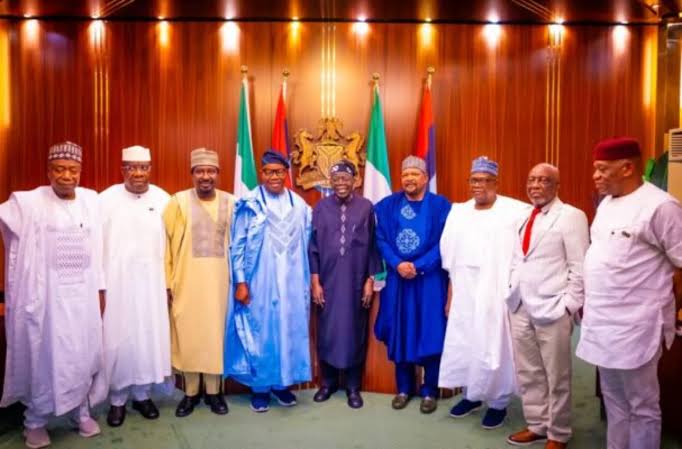
This week, the Senate leadership visited the Presidential Villa to request automatic re-election tickets for all 109 senators ahead of the 2027 general elections. Their logic was straightforward: after handing President Tinubu an automatic ticket for his own re-election bid—waiving primaries and party contests—they expected reciprocity. What they received instead was a political ambush.
According to multiple sources familiar with the meeting, President Tinubu rejected the request outright and directed the senators to return to their respective state governors if they wished to secure tickets for another term. “Go back to your governors,” Tinubu was quoted as saying. “They will decide who returns.”
For senators across the 36 states, this directive is not merely inconvenient. It is a political death sentence.
The Governor-Senator Trap
Under Nigeria’s current electoral framework, state governors exercise enormous influence over party primaries. They control local government chairmen, ward delegates, party executive committees at the state level, and, in many cases, the financial machinery required to run competitive primaries or nomination in the case of consensus. Senators, by contrast, operate at the federal level and typically lack the grassroots party infrastructure necessary to bypass a hostile governor.
The structural reality is that most Nigerian senators and their state governors are not allies. In Lagos, senators have clashed with Governor Babajide Sanwo-Olu over zoning and budgetary matters. In Kano, the political landscape has shifted dramatically. Governor Abba Kabir Yusuf, originally elected under the New Nigeria Peoples Party (NNPP), decamped to the All Progressives Congress (APC) early 2026 following broader northern political realignments. His defection, along with that of several legislators, has left APC senators navigating a complex relationship with a governor who now belongs to their party but arrived through a different political structure. The crisis in Kano remains unresolved, with parallel emirates, conflicting court orders, and a divided state assembly.
In Rivers, the protracted political war between Governor Siminalayi Fubara and his predecessor Nyesom Wike spiraled into a constitutional crisis, culminating in President Tinubu’s declaration of a state of emergency on March 18, 2025. The governor, his deputy, and all elected members of the Rivers State House of Assembly were suspended for six months, and a sole administrator was appointed—a position unknown to the 1999 Constitution. The Senate approved the declaration within hours.
In Zamfara, Governor Dauda Lawal, elected under the Peoples Democratic Party (PDP) in 2023, also decamped to the APC early 2026 and has maintained a frosty relationship with senators from the state.
Across the federation, from Ebonyi to Gombe, governors have openly declared that senators seeking re-election require executive endorsement. By sending senators back to their governors, President Tinubu has effectively thrown 109 political careers into the hands of men with whom most of them are actively feuding. The handful of senators who enjoy cordial relations with their governors—typically relatives or long-standing allies—may survive. The majority will not.
The Senate’s Record of Surrender
To understand why the Senate believed it deserved automatic tickets, one must recall the scale of its legislative subservience since May 2023. Open-source records confirm a pattern of rapid, uncritical approval of executive requests.
On August 7, 2023, the Senate confirmed 45 ministerial nominees. According to the official records of the 10th Senate, several nominees were confirmed with minimal questioning. Senator Sunday Karimi (APC, Kogi West) told one nominee, “You are eminently qualified. I won’t waste time asking questions.”
In June 2023, President Tinubu requested an increase to the nation’s borrowing limit from N22.7 trillion to N56.7 trillion—an additional N34 trillion in debt. The Senate approved the request without a public hearing or sectoral analysis.
In December 2023, the Senate passed the Student Loan Act (Repeal and Re-Enactment) Bill without dissent.
In March 2025, the Senate approved emergency rule in Rivers State within hours, including the suspension of elected officials.
In June 2024, the Senate approved a supplementary budget of N6.2 trillion within 48 hours.
Late 2025, the Senate confirmed the Chairman of INEC via voice vote.
In October 2024, the Senate confirmed 27 Resident Electoral Commissioners in one sitting.
In December 2024, the Senate passed Tax Reform Bills under suspended rules.
Most recently, in February 2026, the Senate confirmed the Inspector General of Police in under an hour.
The Electoral Act Amendment That Changed Everything
Perhaps the most consequential surrender occurred when the Senate participated in passing the Electoral Act Amendment that introduced several controversial clauses affecting electoral accountability.
Notably, the National Assembly amended the provisions governing election petitions, particularly Section 138 of the Electoral Act 2026. Under the revised law, the grounds upon which an election may be challenged were significantly narrowed. The amended section now limits election petitions largely to issues of corrupt practices, non-compliance with the Act, or whether the declared winner secured the majority of lawful votes.
Crucially, the amendment removed certificate forgery and falsification of credentials as explicit grounds for challenging election results at tribunals—a provision that had previously been recognised in electoral jurisprudence.
Legal analysts and civil society organisations have criticised this change, warning that it weakens accountability mechanisms. The amendment also introduced punitive financial penalties for petitioners and their lawyers who file cases outside the limited grounds recognised by the Act, potentially discouraging legitimate legal challenges.
In practical terms, while the 1999 Constitution still disqualifies candidates who present forged certificates, the amended Electoral Act restricts how and where such issues can be litigated after elections, shifting the burden largely to pre-election processes or intra-party challenges.
The Senate did not hold extensive nationwide public hearings on these controversial provisions. The amendment passed amid criticism that lawmakers had narrowed the democratic space rather than expanded it.
The consequences are already visible. In the lead-up to the 2027 elections, concerns have emerged about the ability of electoral mechanisms to effectively screen candidates and address qualification disputes within the post-election legal framework.
As one civil society observer told The Cable: “The Senate was supposed to be the check. Instead, they became the enablers. And now they are surprised that the man they empowered has turned on them.”
What History Teaches: The First Victims of Dictatorship
The Senate’s current predicament follows a well-documented pattern. Across different countries and different eras, the legislators who help entrench executive dominance are consistently among the first to be discarded.
In Weimar Germany, the Reichstag passed the Enabling Act of 1933 by a vote of 444 to 94, handing Adolf Hitler sweeping powers.
In Venezuela, Nicolás Maduro sidelined the legislature after initial cooperation.
In Hungary, Viktor Orbán consolidated parliamentary control.
In Turkey, Recep Tayyip Erdoğan reshaped parliament after 2016.
Political scientist Juan Linz observed: “The legislature that abdicates oversight does not become the executive’s partner. It becomes the executive’s hostage.”
Closer to home, Nigerian historian Dr. Usman Bugaje has noted similar patterns.
The Final Irony: An Admission of Irrelevance
The most revealing aspect of the Senate’s Villa visit is not the rejection but the request itself. By asking for automatic tickets, senators effectively conceded that they cannot win primaries on their own.
Senator Ali Ndume stated: “When you surrender your powers, don’t expect to get them back.”
What Happens Now
The realistic outlook for most senators is grim. Governors across the federation are already identifying candidates for 2027.
Some senators will survive. Most will not.
The Unanswered Questions
What did the Senate gain from its compliance? Will any senator change course? What does this mean for Nigeria’s constitutional balance?
As Ndume put it: “A legislature of ghosts cannot check a president.”
Conclusion
The Senate played itself. It mistook proximity for power, compliance for influence, and favours for favours returned.
President Tinubu does not return loyalty. He consumes it.
The senators who enabled executive dominance are now confronting the oldest law of politics: those who help entrench power are often the first to be discarded.
The Villa door has closed. The governor’s offices are open. And 109 senators are about to learn that in Nigerian politics, loyalty is a one-way street.