
By Patrick PA Okon
In Nigeria’s turbulent democratic journey, only few public figures have left as indelible a mark as the Kauran Bauchi, Senator Bala Abdulkadir Mohammed CON, administrator, journalist, politician, and outstanding son of Bauchi State.
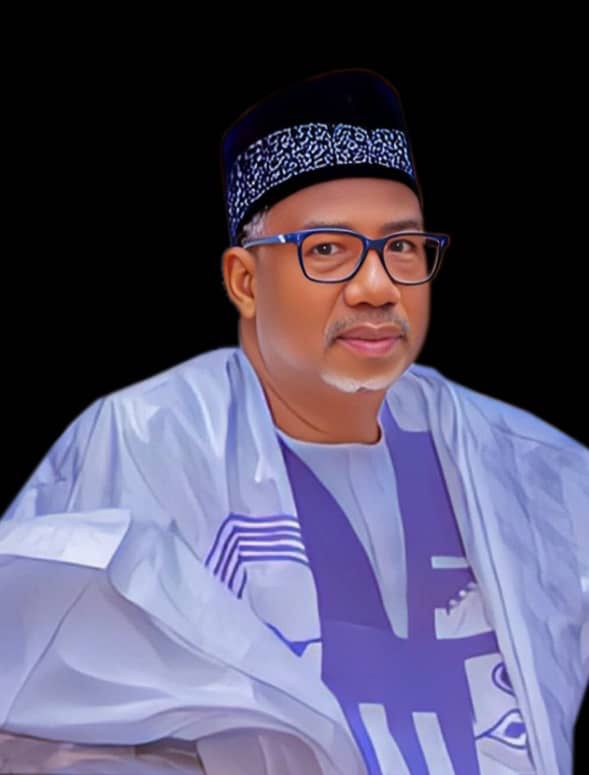
Mohammed’s political career first gained national attention in 2010 when, as a Senator representing Bauchi, he sponsored the Doctrine of Necessity motion. That bold legislative move and pivotal action resolved a constitutional deadlock, legally empowered and paved the way for the then Vice President Goodluck Jonathan to assume presidential powers during President Yar’Adua’s incapacitation. It was a moment that showcased Mohammed’s courage, foresight, and ability to act decisively in national interest.
Governor Bala A. Mohammed fits the bill of a leader born with requisite willpower and vision to better the lots of humanity. He is a steely man of his own conviction, a leader with few words and robust action. In the last seven going to eight years, his actions and programmes, largely guided by tireless efforts, an untainted and unblemished record and a firm principle of putting public interest first, have prioritized infrastructure, education, and healthcare, and positioned him as a reform‑minded leader. His story is one of persistence and reinvention.
It is amazing how time has passed and alongside recorded for him an impeccable score card mirroring his offer to public service, stewed by enormous commitment, dedication and accountability while occupying various positions, delivering innovative policies, programs, and life impacting projects for both the people of Bauchi State and the nation at large.
He defected from the Peoples Democratic Party (PDP) as a sitting governor and Chairman of the PDP Governors’ Forum in early May 2026 to the Allied Peoples Movement APM, and during the 2027 general elections, he will be running on the APM platform to once more get elected to represent the good people of Bauchi South Senatorial District at the upper legislative chamber of the national assembly.
Pundits describe his move to the APM as a collective political movement, that brought with him a significant number of PDP officials, including commissioners, state assembly members, and grassroots supporters; and from various angles the descriptions range from political context, motivation to historical relevance and layer on undemocratic practices and internal crises within the PDP as reasons for his defection, even as the APM aligns better with his values of good governance and internal democracy.
Mohammed is well-equipped with political relevance having previously served as a Senator for BSSD from 2007 to 2010 under the All Nigeria Peoples Party (ANPP) before becoming governor. He will be facing opposition from other parties with candidates like Dr. Danjuma Dabo of the PDP and Yakubu Shehu Abdullahi of the APC in the upcoming election.
This is the beauty of multi-party democracy which he firmly stood for in his former party, the PDP, against the one-party agenda of the Tinubu-led APC government that have planted moles everywhere to destabilise and intimidate the opposition using government institutions, including even the judiciary, legislature and the Independent National Electoral Commission, INEC.
Analytically, his bid under the APM would be justified by his blend of national visibility and local governance experience having widely consulted his people and garnered their consent. And voters will expect him to leverage on his executive insights to strengthen legislative oversight and policy advocacy contrary to some analyst’s caution that returning to the Senate after governorship could be perceived as a lateral move rather than upward progression.
Mohammed’s career illustrates the trajectory of a politician who has successfully navigated Nigeria’s legislative and executive arenas. And once again, his Doctrine of Necessity motion in 2010 remains a landmark in constitutional history, showing his ability to act decisively in moments of national crisis. This was his most defining achievement in the Nigerian Senate (2007–2010); because if Bala Mohammed and fellow patriots had not insisted that it was wrong to deny Jonathan his constitutional right because he came from the South-South, if they had decided to roughshod the people of the Niger-Delta, who knows if there would have been a country called Nigeria today? Talk about statesmanship: the ability to be driven by a sublime vision of the country’s future as against the narrow temporal benefits anchored on personal gains or narrow ethnic interests.
Upon assuming responsibility as the Acting President, Jonathan appointed him as Federal Capital Territory Minister, because he (Bala) was known to be detribalised, hoping that people from every part of the country would be given the opportunity to serve their fatherland.
And, as FCT Minister, he demonstrated administrative boldness, though he inherited the daunting task of managing Abuja’s rapid growth, his tenure was marked by ambitious infrastructure projects, reforms in land administration and efforts to modernize the capital territory amidst a willingness to confront entrenched bureaucratic inefficiencies. All the same, Abuja’s expansion during this period cemented his reputation as a leader capable of shaping urban policy at scale.
Elected to represent Bauchi South in 2007, his legislative and oversight track record included key committee roles where he served as Vice Chairman – Senate Committee on Aviation, Secretary of the Northern Senators Forum aside broad oversights as an active member in several critical committees like Communications, Finance, Public Accounts, Rules and Business, Environment, and Labour and Productivity as well as Member, Senate Ad-hoc Committee on Jos crisis.
Recall that in his first contest aspiring to represent Bauchi South Senatorial District under the platform of the defunct All Nigerian People’s Party (ANPP), in 2007, Bala Mohammed who was then a retired civil servant, defeated, by a landslide, Ahmad Adamu Muazu, who was a powerfully sitting governor. Despite being a first-timer in the Senate Chamber, he within a short space of time, acclimatized himself with the environment and became one of the vibrant Senators during plenary as well as one of the foremost outspoken legislators in Nigeria. His vocal advocacy led to his being recognized as one of the most outspoken legislators during his tenure, actively contributing to debates on national economic issues and governance.
In 2027, Bauchi South faces a choice: continuity of proven leadership or experimentation with untested hands. Bala Mohammed, with his record as Senator, Minister, and Governor, offers a ticket grounded in experience. His candidacy under APM is not just about returning to the Senate; it is about bringing Bauchi’s voice to the national stage with renewed strength.
Supporters argue that his governance track record justifies the ticket: roads built, schools expanded, hospitals revitalized. They expect him to champion Bauchi’s interests in Abuja, ensuring that the state’s development agenda aligns with national policy.
The 2027 campaign narrative positions him as the candidate of stability, competence, and vision – a leader who has walked the corridors of power and now seeks to use that experience for Bauchi’s benefit. And looking ahead, the 2027 senatorial elections present an opportunity to return to the legislature with the benefit of executive experience. His candidacy under the Allied Peoples Movement (APM) is driven by a desire to amplify Bauchi’s voice at the national level, to bring the lessons of governance back into policymaking, and to ensure that his people’s needs are represented with vigour.
Governor Bala Mohammed is contesting the Senate position not as a retirement home but as another opportunity to continue with the good works he started between 2007 and 2010.
Reason why supporters and stakeholders across the local government areas of Alkaleri, Bauchi, Bogoro, Dass, Kirfi, Tafawa Balewa, and Toro in the Bauchi South Senatorial District of Bauchi State have pledged support for the senatorial ambition of Governor Mohammed ahead of the 2027 general elections through the newly-unveiled Mohammed Bello Maiwada-led “Kaura Movement” – a platform, whose initiative is to mobilise wider grassroots support for the governor’s senatorial ambition in 2027.
The movement which comprises respected elders, youths, women groups, political stakeholders and intellectuals drawn from across the zone, all working collectively to strengthen the political fortunes of the party and ensure continued democratic leadership in the state describe Governor Bala as a committed democrat and grassroots politician whose administration has continued to execute meaningful developmental projects across Bauchi State.
Born on October 5, 1958, in Duguri Town, Alkaleri LGA, his educational journey began at Duguri Primary School, Bauchi, where he obtained his First School Leaving Certificate in 1971. He proceeded to Government Secondary School, Bauchi, completing his WASCE in 1976. In pursuit of higher education, he attended the North-East College of Art and Science from 1977 to 1979 for his Advanced Level Certificate. Senator Mohammed graduated from the University of Maiduguri in 1982 with a Bachelor of Arts in English Language; and thereafter enhanced his professional competencies through several capacity-building programs at the Administrative Staff College of Nigeria (ASCON) and the Institute of Purchase & Supplies in Lagos.
A career journalist who worked with The Mirage Newspaper in Jos, News Agency of Nigeria (NAN) and The Democrat Newspaper before transiting into public service that began at the Federal Ministry of Internal Affairs, Abuja; through the Cabinet Secretariat of the Presidency, Federal Ministry of Solid Minerals, Federal Ministry of Power and Steel, Federal Ministry of Transport, Nigerian Railway Corporation and later the Nigerian Meteorological Agency, before his political career began. His hobbies include reading, writing and strolling.
In reflection, his journey has been one of service across multiple arenas – legislative, executive, and grassroots. Each role has taught him resilience, compromise, and the importance of vision.
The autobiography of his life is not just about positions held, but about the enduring belief that leadership is service, and service is sacrifice. Premise on which his colleagues describe him as pragmatic, ambitious, and deeply connected to grassroots politics. His ability to balance national prominence with local relevance has kept him in the spotlight. For Bauchi citizens, his career embodies the possibility of leadership that bridges rural needs with national policy making.
Patrick PA Okon – a Public Affairs Analyst writes from Abuja.