

When President Bola Tinubu promised Nigerians a Renewed Hope Agenda, the scepticism among Nigerians was so strong because of many unfulfilled campaign promises, and they were dismissive of it as another hope soon to be dashed. While some schools of thought thought that the new administration should be given the benefit of the doubt, both sceptics and optimists agreed it would take a while for the vision and promises to become a reality and definitely not in four years, or the first term of Tinubu’s presidency.
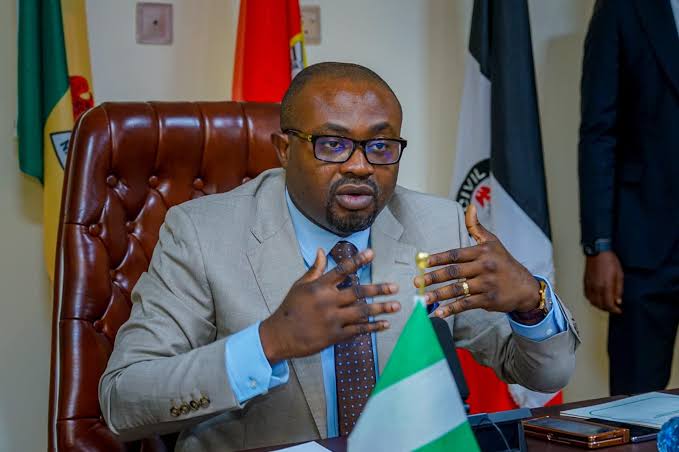
The Minister of Interior, Olubunmi Tunji-Ojo, is pivotal to repositioning, reforming, and reorganising the Nigeria Immigration Service and passport services. Nigerians can now obtain a new passport seamlessly, without being fleeced by immigration officials.
In the last three years, all the agencies under the watch of Olubunmi Tunji-Ojo have witnessed the digital transformation in their service delivery. He mandated the strict institutional digitisation and enterprise content management systems (Interas) across the ministry to enforce transparency and curb bureaucratic inefficiency.
This further promoted institutional discipline, as the hallmark of that policy is electronic correspondence across departments and agencies of the Ministry of Interior.
His digitisation move resolved the National Identification Number modification backlog. This move tackled and resolved an inherited backlog of roughly 2.5 million requests. This was critical to the efficiency of the process of renewing or obtaining a new passport, which is widely celebrated.
He spearheaded the deployment of e-gates at major international airports to streamline processing and elevate border surveillance.
He didn’t stop at reforms aimed at improving service delivery of agencies under his oversight; he also improved the institutional framework and improved welfare and working conditions across these agencies.
To achieve this, he first embarked on prison decongestion by raising significant funds via public-private partnerships to pay off fines for minor offenders, thereby freeing over 4,000 inmates and cutting feeding expenditures. This also reduced the burden of managing inmates in overcrowded prison facilities.
He then recruited scores of medical personnel and upgraded infrastructure and health standards across custodial centres, and this was responsible for the first-ever major surgery performed on an inmate at the Kuje Correctional Facility.
Tunji-Ojo has entrenched discipline in the agencies under his watch. On two occasions, he ordered a probe into an act of misconduct by personnel of the Nigeria Correctional Service. The first issue involved accusations of corruption and inappropriate behaviour. It was alleged that Idris Okuneye, also known as Bobrisky, who was serving a six-month sentence in a correctional facility, was allowed to sleep outside the prison walls during his incarceration.
The panel stated that Bobrisky remained inside the custodial centre, but pointed out procedural violations and backdated documentation regarding his transfers between custodial centres, and affirmed that evidence showed he had unauthorised access to communication devices and frequent, unrestricted visits.
Consequently, some senior NCoS officers, including Michael Anugwa and Sikiru Adekunle, and other top controllers at Kirikiri were suspended to allow for an unbiased investigation.
This was a demonstration of zero tolerance for indiscipline, unprofessionalism and corruption which had plagued the service before Tunji- Ojo resumed office as the Minister of Interior.
The same standard and procedure were extended to the allegations of misconduct and criminal activities within the Okere Correctional Centre in Warri, Delta State. The resultant probe led authorities to move more than 150 prisoners from Okere to custodial facilities in northern Nigeria, while the minister instituted wide-ranging administrative reviews and personnel removals to crack down on compromised internal security protocols.
There has been no jailbreak since Tunji-Ojo became interior minister, something which was a regular occurrence in the last five years.
Under him, there have been yearly promotion exercises for thousands of paramilitary personnel across immigration, correctional, and civil defence units. So, 100,000 paramilitary officers were promoted within two years, while recruitment approvals were secured for 30,000 personnel, and a Paramilitary Pensions Board was established to address long-standing retirement anxieties.
He made the signing of the performance bond with heads of agencies under him compulsory. Recently, during the signing of the 2026 performance bond with the service heads, he made them see it as proof of commitment to fulfilment of mandates after a performance review by the agencies.
The minister commended the services for their dedication, focus and tremendous contribution to nation-building, noting that to whom much was given, much was expected, as President Tinubu had invested his trust in them, so there was no room to betray the trust.
Lastly, Tunji-Ojo has enhanced the operational capabilities of all the agencies under his supervision. He facilitated the establishment of specialised units, such as the Mining Marshals and dedicated railway commands under the Nigeria Security and Civil Defence Corps, aimed at protecting critical national infrastructure.
There has been improved investment in the Federal Fire Service by expanding its logistics and fleet deployments for the service, reducing overall national property loss from fire incidents.
Femi Salako is a media consultant to the Minister of Interior